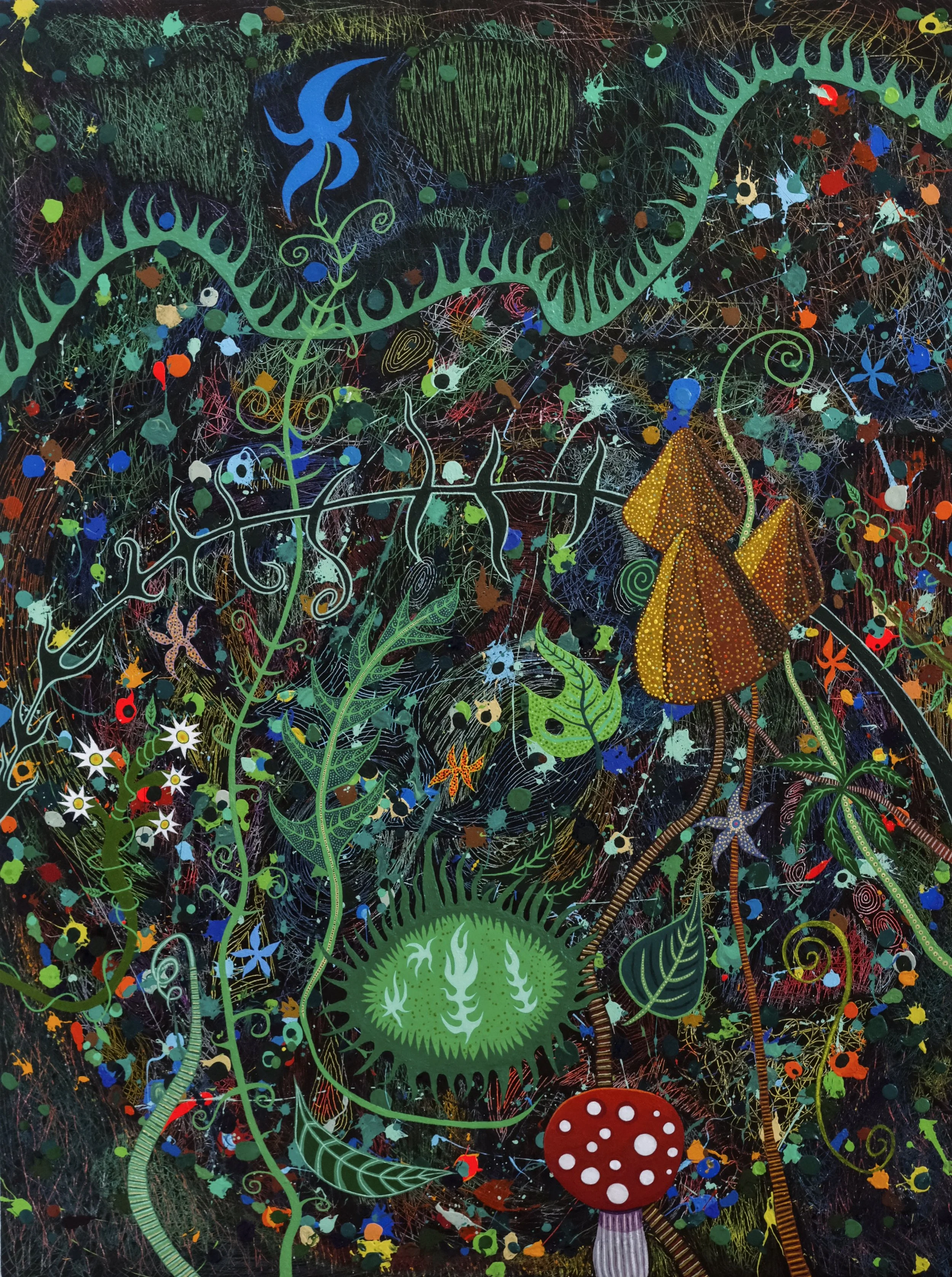
“Overgrown” examines interconnected systems of existence through constructed environments that oscillate between the biological and the imagined. Landscape is approached not as scenery but as a mutable field shaped by emergence, decay, and continual reconfiguration. Rather than depicting ecosystems as they appear, the work constructs relational environments that unfold through accumulation, interruption, and transformation.
The process is iterative and materially driven. Surfaces develop through layering, scraping, obscuring, and rebuilding. Mark-making operates as both inscription and erosion. Repetition generates density, while erasure introduces entropy as a generative force. Each painting registers a cycle of construction and dissolution rather than a fixed resolution. Organic forms hover at the threshold of legibility, suggesting vegetal or cellular structures without resolving into definitive imagery. Within this liminal space, binaries destabilize: interior and exterior, order and disorder, presence and absence. Structure does not eliminate chaos; it emerges through it. Color and pattern function architecturally, producing space rather than describing it. Dense chromatic networks create immersive visual ecologies without hierarchical focal points. What initially appears chaotic gradually reveals an internal rhythm through sustained attention. Meaning unfolds over time.
Overgrown refers to proliferation beyond containment. Growth is neither idealized nor controlled. It is dense, unruly, and continuous. Within that density lies endurance. Systems persist not through stability, but through adaptation and flux.
by Katarina Ortiz